Days shaped by the terrain
In Norway, terrain is not a scenic background for photography; it is the physical framework that dictates your daily energy, your pacing, and your respect for changing weather. Marking trails with red paint cairns and trusting communal mountain cabins are traditions forged over a century.
The Marked Path Tradition: The Red 'T'
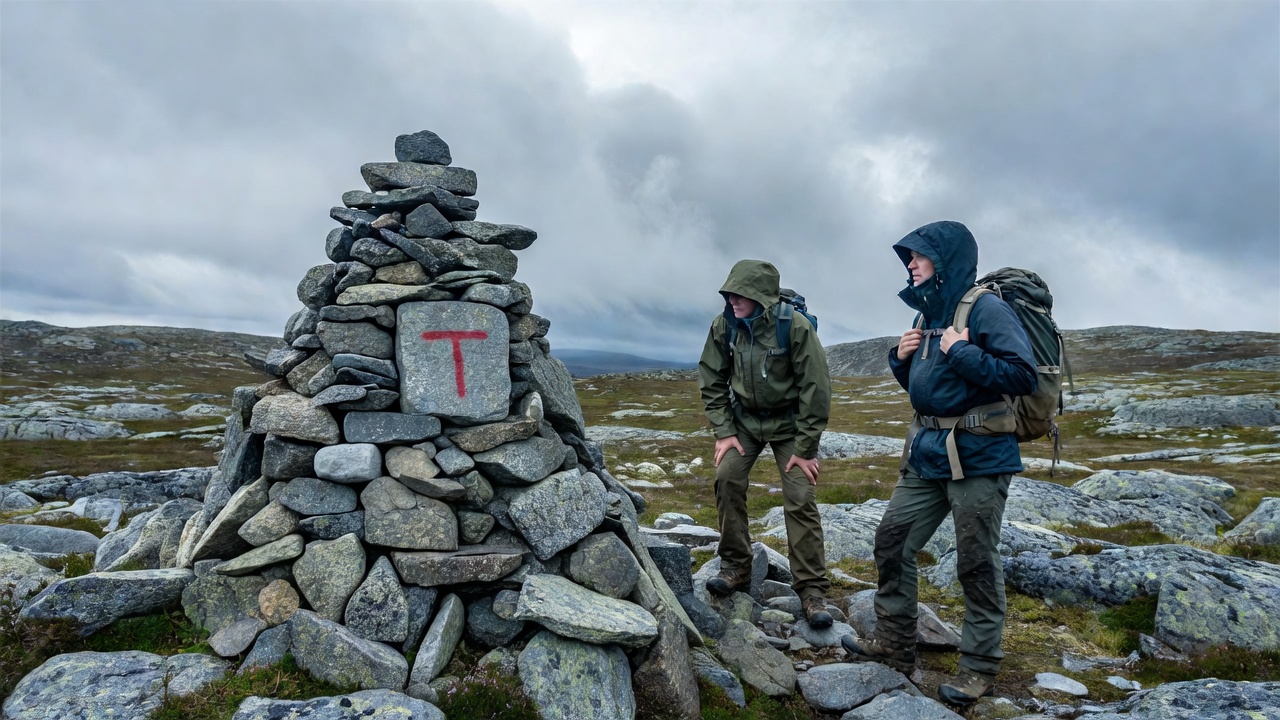
Throughout the country’s mountain parks—from Jotunheimen to Hardangervidda—hikers follow stone cairns painted with a clean red letter 'T'. Maintained by Den Norske Turistforening (DNT) and thousands of volunteer trail stewards, these markers indicate routes vetted for standard safety during seasonable summer conditions.
However, marked does not mean easy. Norwegian trails are deliberately left rugged: you will encounter scree fields, slippery birch root steps, unbridged snowmelt stream crossings, and exposed knife-edge ridges where balance and sure footing are essential.
1. The DNT Cabin Network: Trust and Simplicity
One of the greatest cultural institutions in Scandinavia is the mountain cabin (hytte) system. Across Norway, over 550 huts exist in three operational tiers:
- Ubetjent (Unserviced): Basic timber lodges with firewood, gas stoves, and bunks, but no provisions. You carry your own food and leave the hut spotless for the next traveller.
- Selvbetjent (Self-serviced): Fully equipped cabins stocked with a pantry of preserved provisions (oats, tinned meats, crispbread, soups). Guests take what they need, record their consumption in a written ledger, and pay via mobile invoicing.
- Betjent (Serviced): Larger alpine lodges where staff prepare hearty three-course evening meals based on local ingredients (cured meats, reindeer stew, mountain trout) and bake fresh morning bread.
Access to unserviced and self-serviced cabins requires the universal standard DNT brass key, which can be acquired by joining the association either online or at city chapter outposts in Oslo, Bergen, or Tromsø.
2. Navigating Coastal Fjords by Kayak
From the highway, a fjord appears as a deep mirror between sheer walls. From a sea kayak, its real scale becomes apparent. Paddling through Nærøyfjorden or the quieter arms of Hjørundfjorden reveals sea caves, tiny abandoned goat farms clinging to steep rock ledges, and tidal currents pulling through narrow sounds.
Independent paddlers must understand that water temperatures rarely exceed 12°C even in midsummer. A drysuit, spray skirt, reliable VHF communication, and clear knowledge of wake surges caused by fast express catamarans are mandatory prerequisites.
3. High Ridge Traversals: Beyond Besseggen
Besseggen Ridge in Jotunheimen draws up to 60,000 hikers every summer, causing crowded ferry crossings across Lake Gjende. Those seeking solitude can turn to comparable, less-trafficked alpine ridges:
- Romsdalseggen (Alternate Corridors): While the standard ridge is famous, traversing through the Venjetindan valley offers towering gneiss pillars with quiet side scrambles.
- The Seven Sisters (Sju Søstre): Located on Alsten island along the Helgeland coast, these seven continuous summits can be tackled individually or traversed in a single gruelling 12-hour expedition above the open Atlantic.
- Dronningruta (The Queen's Route): A coastal ridge linking Stø and Nyksund on the Vesterålen islands, combining jagged sea cliffs with deserted white sand beaches.
Essential Trail Etiquette & Safety Matrix
| Principle | Traditional Rule | Practical Consequence |
|---|---|---|
| Allemannsretten | Right to Roam (Outdoor Recreation Act) | Camp at least 150m away from inhabited homes; strictly no open fires between April 15 and September 15. |
| Fjellvettreglene | The Norwegian Mountain Code | Plan your route and declare it; adapt to your fitness and conditions; turn back in time—there is no shame in retreating. |
| Waste Packing | Leave No Trace | Carry all waste back down, including hygiene items and food peels which take years to decompose in cold alpine soils. |
| Drinking Water | Free Surface Flow | Fast-running alpine streams above farm altitude are generally pure; avoid stagnant pools or glacial silt runoff without filtration. |